Loading page
Extracurriculars by major
Extracurriculars for Mathematics Majors
A mathematics application reads best when your activities show you engage with math as a creative discipline, not just a school subject. These six activities move from a first math team and local math circle all the way to founding a tutoring nonprofit or reaching the national olympiad team.

Explorer
Start here and build momentum
Join your school math team and start the AMC pathway
Most schools with a math team run AMC 8, AMC 10, and AMC 12 practice sessions, which builds the problem-solving instincts that carry through every higher competition. The AMC 10 and 12 are the entry point to the AIME, USAMO pipeline, so starting early matters. Even if competition results are modest at first, the discipline of working through unfamiliar problems every week is itself visible in the depth of your application essays.
Find a math team path
Attend or start a math circle
Math circles are weekly or biweekly sessions where students work on non-routine problems guided by a mathematician, usually a university professor or graduate student. They exist at universities across the country, and several run Saturday programs open to high schoolers from outside their campus. If your area does not have one, the National Association of Math Circles has resources for starting a chapter, and founding one gives you the strongest possible line.
Find math enrichment programsStrategist
Compete and get noticed
Attend PROMYS, Ross, or Canada/USA Mathcamp
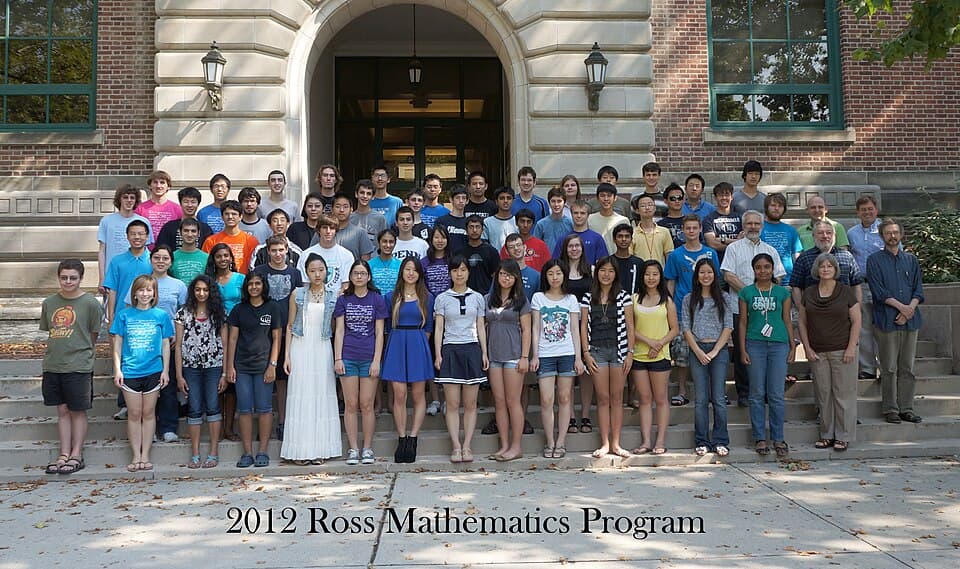
PROMYS at Boston University, the Ross Mathematics Program at Ohio State, and Canada/USA Mathcamp are the three most selective residential summer programs for mathematically talented students. Each immerses you in a cohort of serious problem-solvers and real mathematical research for four to six weeks. Admission itself is a competitive credential, and the proof-writing and independent thinking you develop there translates directly into stronger competition performance and better college essays.
Explore PROMYS and summer math programs
Target AIME qualification and HMMT or ARML
Qualifying for the AIME by scoring above the cutoff on the AMC 10 or 12 is the first nationally recognized benchmark on the math olympiad path. HMMT (Harvard-MIT Mathematics Tournament) and ARML (American Regions Mathematics League) are team competitions with national-level participation where individual and team scores are publicly ranked. A strong HMMT individual score or a top-ranked ARML team performance gives you a concrete external measure to cite.
Build toward AIME and beyondMythic
Build something exceptional

Found a math circle or math tutoring nonprofit
Starting an organization that teaches math to students who would not otherwise have access to it is the rarest signal a math applicant can show: you are doing mathematics and giving it away at the same time. A successful math circle or tutoring nonprofit requires you to recruit mentors, write curriculum, and sustain a program across a school year. It is the clearest proof that your interest in the subject extends beyond your own test scores.
Explore math organization models
Qualify for USAMO and target MOP or IMO
The USAMO is one of the most selective individual competitions in American high school mathematics; roughly 500 students qualify each year from tens of thousands of AMC participants. USAMO qualifiers with high scores are invited to the Mathematical Olympiad Program (MOP), a summer training camp from which the USA team for the International Mathematical Olympiad is selected. A USAMO qualification alone is a line that every top math program recognizes immediately.
See the IMO and MOP pathwayQuestions, answered
Extracurriculars for mathematics majors, explained
What extracurriculars help with a mathematics major application?
The strongest math extracurriculars show engagement with mathematics beyond coursework: a competition pathway from AMC through AIME, attendance at a selective summer program like PROMYS or Mathcamp, and ideally something you created, whether a math circle, a tutoring program, or original research. Admissions readers at top math departments want to see that you do math for its own sake, not only to get grades.
How important is USAMO for top math programs?
A USAMO qualification is one of the strongest single signals for elite math programs like MIT, Harvard, Princeton, and Caltech. It is not strictly required, but the overlap between USAMO qualifiers and top-admit math students is very high. If you are within range of qualifying, treating the AMC-to-AIME-to-USAMO path as a multi-year goal is worth the investment.
What if I am good at math but not at competitions?
Research and founding activities carry comparable weight. A student who attended PROMYS and wrote a strong original problem set or did genuine number-theory research with a professor is just as compelling to admissions readers as a solid AIME performer. Competitions measure speed and pattern recognition; research and teaching measure a different and equally valued kind of mathematical maturity.
Build your roadmap
Answer four questions and get a personalized plan with activities and opportunities near you.