

Founder field notes
How SmashSpeed built a speed tracker used by 50,000 players
A practical look at learning the hard technology, shipping a mobile app, and turning one repeatable social format into global growth.


- 50,000
- players
- 4.8
- App Store rating
- iOS + Android
- mobile platforms
- On-device
- AI analysis
01. Meet SmashSpeed
Give any phone video a smash-speed readout
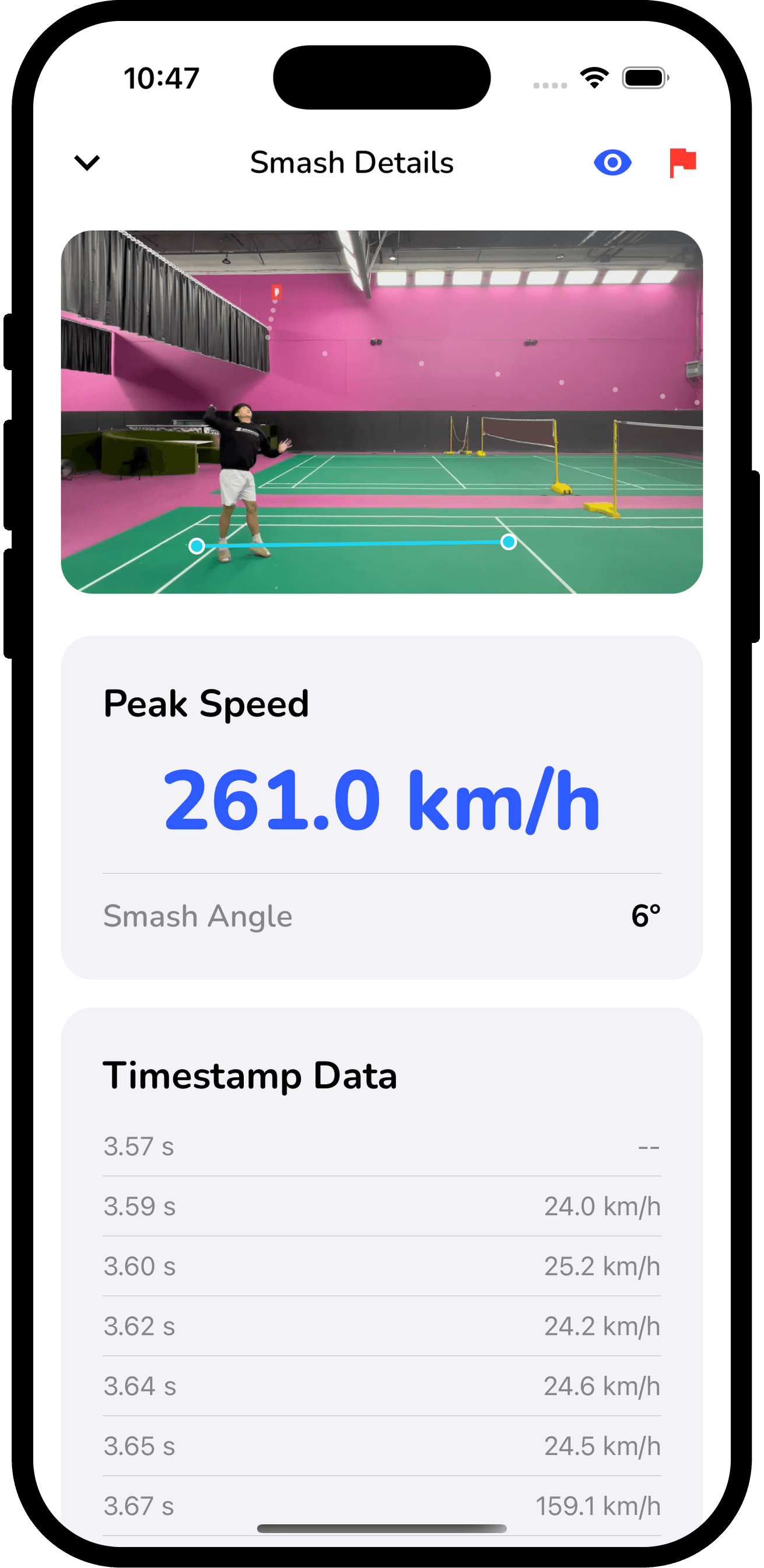
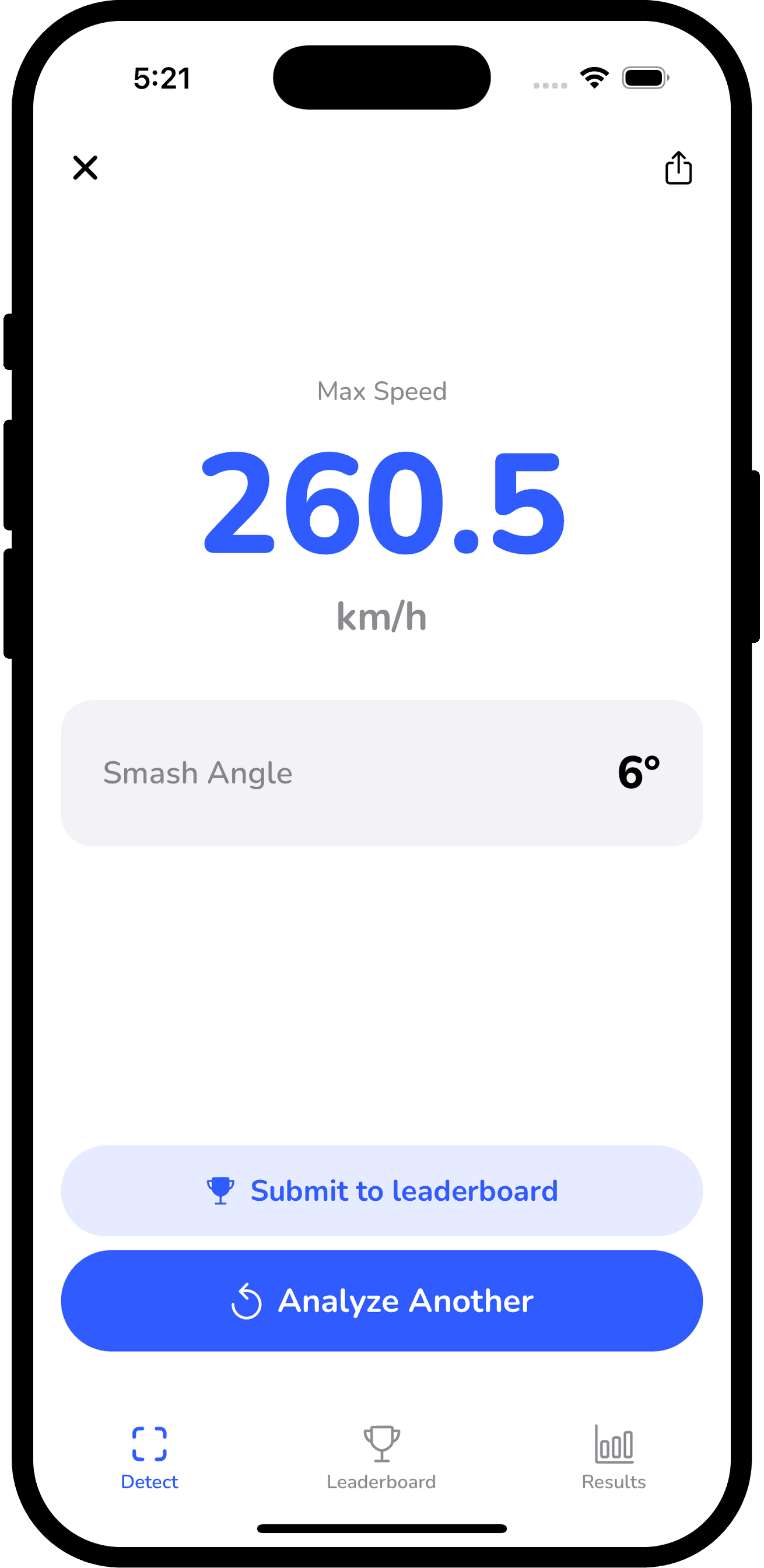
SmashSpeed is an iOS and Android app that measures the speed of your badminton smash from an ordinary video. It uses computer vision to track the shuttlecock frame by frame, then applies physics to turn that motion into a single number. The goal is to bridge the gap between technology and badminton, a niche sport with far less accessible tech than tennis or padel.
Any court video works. No radar gun and no special hardware required.
On-device computer vision follows the shuttlecock through every frame.
Physics converts the motion into a smash speed you can act on.


02. The leaderboard
One accessible number that ranks players

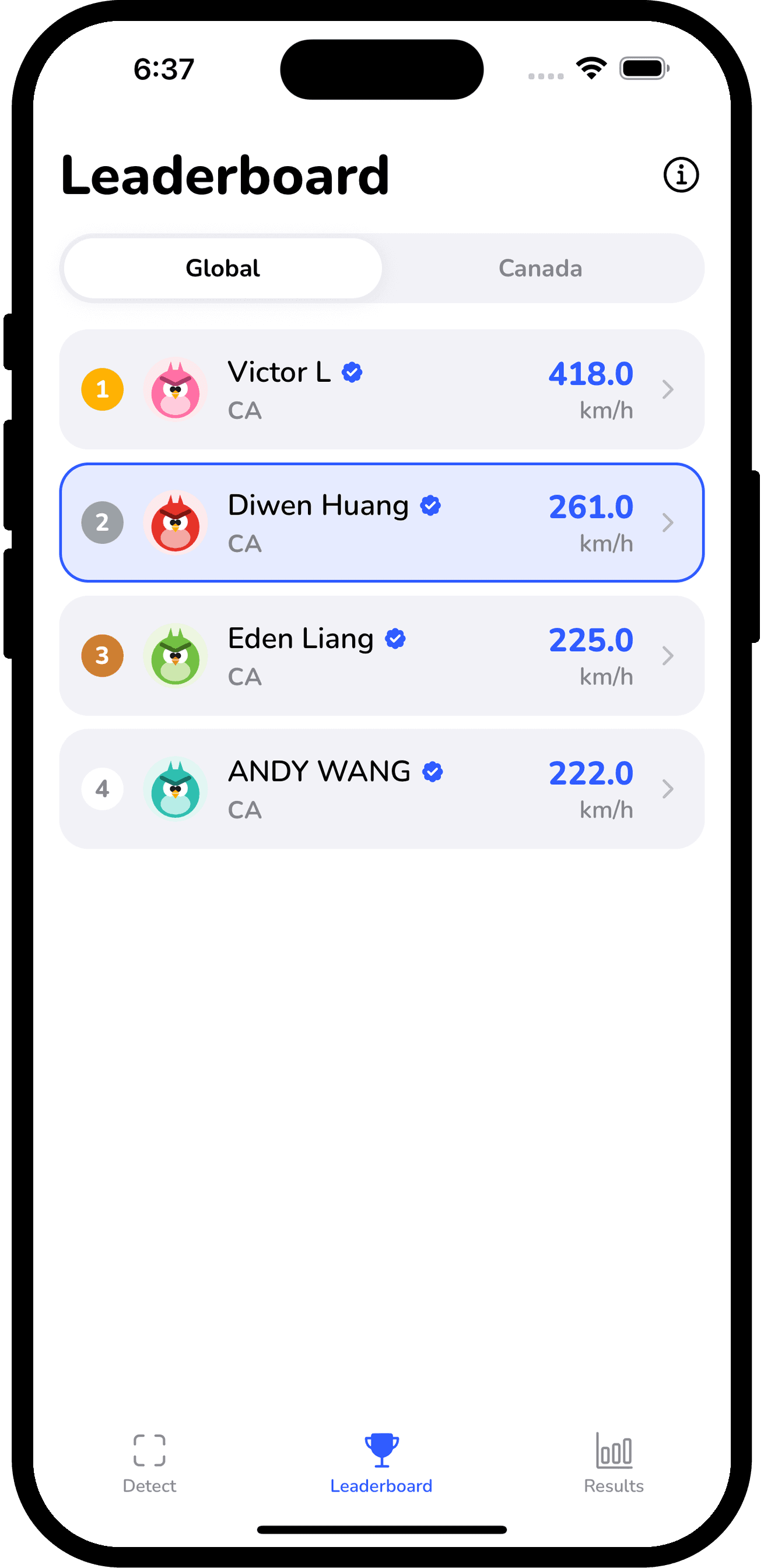
Tournament rankings depend on access and repeated competition, and radar equipment is expensive. SmashSpeed replaces all of that with one shared metric. Every measured smash lands on a global leaderboard, so a player anywhere can see where they stand and what to chase next.
- Global standing. Your smash sits on one worldwide board, not a provincial ranking that takes tournaments to earn.
- A target to beat. Seeing the next speed up the board turns a single reading into a training goal.
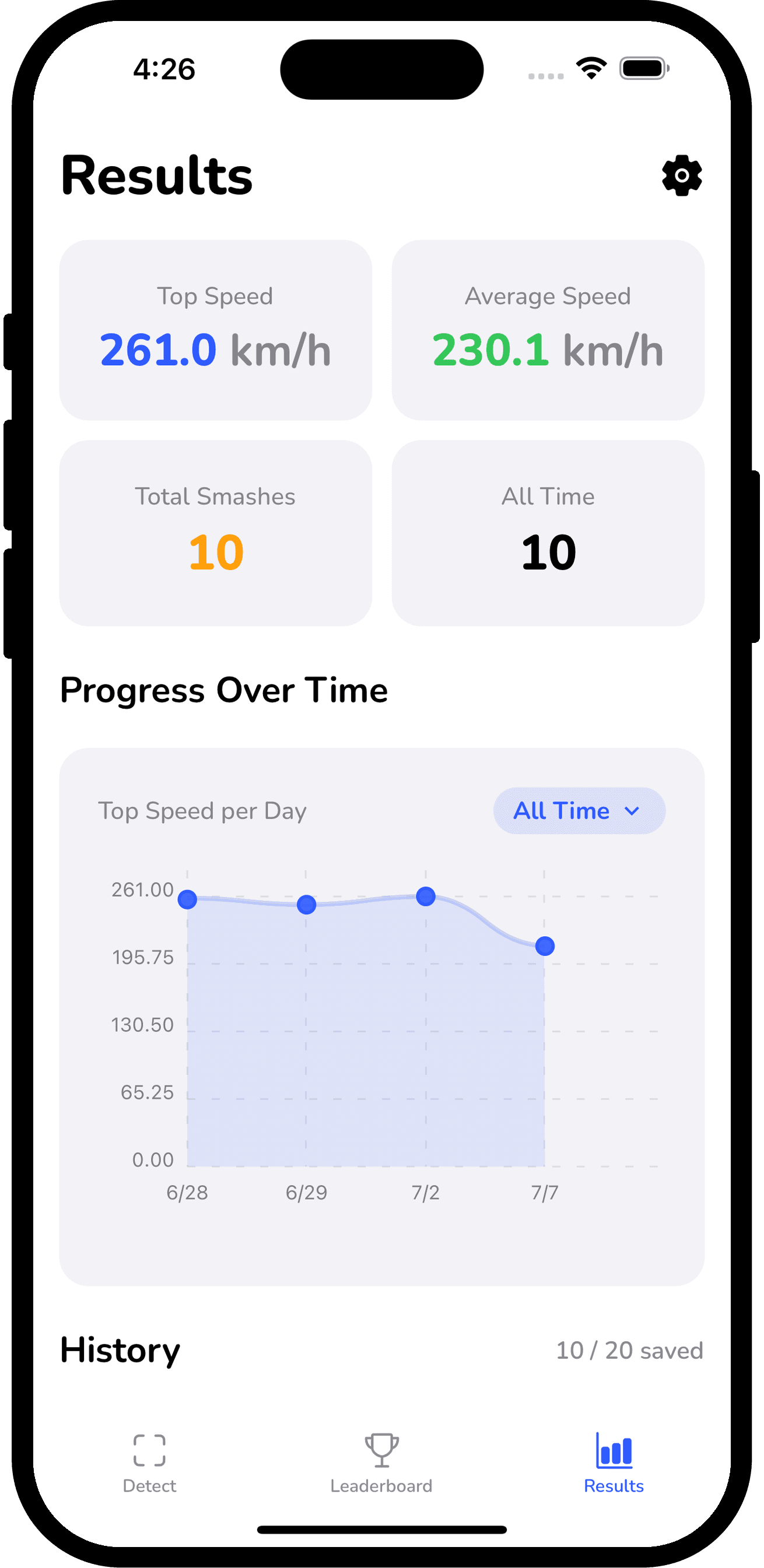
- Progress over time. Repeat readings show whether training is actually moving the number.

03. The build
Learn first, then compress the idea into a product
He knew the app would need computer vision and machine learning he did not have yet, so the project started as coursework, not code. Once the foundations were in place the whole build compressed into one intense summer.
Can you walk me through the technical journey from the initial idea to the app that exists today?
“I got the idea in early 2025. I knew there would be computer vision and machine learning involved and I didn’t think I was ready, so I spent two to three months on Coursera coursework learning machine learning and the prerequisite math. At the beginning of the summer I started building, and I pretty much camped at a café for around 12 hours a day until the app was done.”Diwen Huang
Early 2025
Spot the missing number
Badminton had no accessible metric players could compare. Diwen picked smash speed as one clear, useful benchmark.
2 to 3 months
Learn the foundations
Grade 10 coursework was light on machine learning, so he studied ML and the prerequisite math before building.
CourseraMachine Learning SpecializationStart of summer
Build at the café
Roughly 12 hours a day turned the idea into a working computer-vision app that tracks a shuttle and computes its speed.
After launch
Pair it with distribution
Instagram, TikTok, shareable results, and word of mouth carried the product through the badminton community.
04. The launch
Publishing is another product problem
Coding the app is only half of shipping it. The rest is Apple’s review queue: metadata, compliance policies for every country, and rounds of feedback that each send you back to the end of the line. First-time developers feel the wait more than the work.
- Submit
Metadata, support and marketing URLs, per-country policies.
- Wait for review
Days in Apple's queue with no control over the timing.
- Get flagged
Account deletion, no hard paywall, policy details.
- Fix, resubmit
Back to the bottom of the line each round.
- Approved
Straightforward once the checklist is clear.
What should a first-time student developer expect when publishing an app?
“You pay for an Apple developer account, about 99 USD a year, fill out metadata like descriptions and support and marketing URLs, and sign compliance contracts for each country. Apple gives a few rounds of feedback on specific details, like needing a delete-account feature or not having a hard paywall. Once you fix those, it is straightforward.”Diwen Huang
05. The growth system
Find a viral format you can afford to repeat
What strategy contributed the most to your growth, and why did it work?
“The best strategy was finding a viral format that was easy enough to keep reproducing and feasible to make different each time so it doesn’t get repetitive. For us that was the interview format: ask someone how fast they think they can smash, show their actual smash, then show their reaction.”Diwen Huang
The format has a prediction, an action, a reveal, and a human reaction, and it fits the setting naturally. One tournament or club visit can create weeks of footage. Diwen doesn’t expect every reel to hit, he plans for roughly one viral post in every 10 to 15, because the format is cheap to reproduce and a single breakout brings in a wave of new users.
SmashSpeed’s viral format
How fast do you think you can smash?
Capture the actual attempt on court.
Display the measured speed.
Keep the player’s honest response.
06. The one lesson
Treat your public image as part of the product
What is one highly specific piece of advice for creating and launching an app?
“Your public image for whatever app you’re creating is very important, and that starts with your logo. It has to have a very clear color theme, simple enough that someone could draw it out. That extends to your landing page, your social media page, and your username. Even if your idea is not that good, if the image is good, people are more lenient about trying it.”Diwen Huang

SmashSpeed follows its own advice. The mark is deliberately simple, which is exactly why it works as a first impression across the app icon, the website, and every social handle.
- One clear color. A single blue theme carries the whole brand.
- One recognizable icon. A shuttlecock in motion says the whole idea instantly.
- Drawable from memory. Simple enough that someone could sketch it by hand.
One tangible takeaway
Design the logo, landing page, and handles before you chase users.
First impressions decide whether someone even tries the app. A clear, simple, consistent visual identity buys goodwill that a rough idea can borrow against.07. Build your own version
A practical roadmap for a student starting with an app idea
Based on Diwen’s interview advice and the sequence SmashSpeed followed.
Find the idea
Start inside your own circle
- Write down a problem you repeatedly notice
- Choose one measurable outcome
- Check whether existing tools solve it well
Prepare
Learn only what the build needs
- Choose the platform and language
- Study the required technical foundations
- Understand the code even when tools help write it
Ship
Plan for distribution requirements
- Create support and marketing pages
- Prepare store metadata and policies
- Expect review feedback and revise quickly
Grow
Find one repeatable story format
- Film where the product is naturally used
- Batch enough content for several weeks
- Make the result easy for users to share
The complete conversation with Diwen
Every question we asked, with Diwen’s full answers. Responses are edited lightly for clarity. Open any question to read the reply.
What is the app you created? Can you tell me more about it?
It's an iOS and Android app where you give it a video and it measures the speed of your smash using computer vision and physics. It aims to bridge the gap between technology and badminton, which is usually a niche sport with much less accessible technology compared to bigger racket sports like tennis or padel.
Diwen HuangWhat specific experience or problem inspired you to create SmashSpeed?
In badminton, and a lot of other sports, there isn't really an accessible ranking system. I wanted to create a benchmark for players to compare with each other. Right now the only quantifiable metric is something like provincial ranking, and that isn't accessible because you have to play a lot of tournaments to earn points. I wanted one accessible metric to compare players.
Diwen HuangCan you walk me through the technical journey from your initial idea to the app today, and how you marketed it?
I got the idea in early 2025. I knew there would be computer vision and machine learning involved and I didn't think I was ready, since grade 10 school coursework is pretty light. So I did two to three months of coursework on Coursera learning machine learning and the prerequisite math. At the beginning of the summer I actually started building. I pretty much camped at a café for around 12 hours a day and got the app done. After that came the hard part, marketing. I thought at first there wouldn't be much demand, but we went viral pretty quickly, I saw how easily you can get traction, and everything grew exponentially from there.
Diwen HuangWhere did you market the app? Was it social media or talking to friends?
At first we did social media on Instagram and TikTok, and those went well. After that it was one user telling a friend, and that friend telling another friend, so we got a lot of free marketing from word of mouth.
Diwen HuangWhat made people want to tell their friends? Is there a screen worth sharing?
In the results screen we explicitly made shareable graphics that you can export, because we wanted to make it really easy to share with your friends. I also think the idea itself is viral enough that you want to tell a friend.
Diwen HuangWhat did publishing on the App Store and Google Play look like, and what should a first-time student developer expect?
First you pick a language. The two biggest options are Swift, which is only for Apple, or React Native, which works for both Apple and Android. We started on Swift but quickly realized React Native was much more efficient. After you code the app you pay for an Apple developer account, about 99 USD a year. Then you fill out a lot of metadata like descriptions, support URLs, and marketing URLs, and sign compliance contracts and policies for each country you want to distribute to. Those steps are mechanical and intuitive. You submit to Apple and they usually give a few rounds of feedback on specific details that get flagged, for example needing a delete-account feature or not having a hard paywall. Once you fix those, it is straightforward and gets accepted.
Diwen HuangWhat kind of videos did you post, what strategy contributed most to growth, and why did it work?
The best strategy was finding a viral format that was easy enough to keep reproducing and also feasible to make different each time so it doesn't get repetitive. For us that was the interview format: we ask someone how fast they think they can smash, show their actual smash, then show their reaction. It works because it goes viral and it's easy to get a lot of them. You head out to a tournament or your local badminton club, film a bunch in an hour that you dedicate purely to filming, and then you have about two weeks of content to edit.
Diwen HuangDid you go viral every video? What was your mindset while marketing?
When we post reels we don't expect to go viral every time. We expect the bare minimum, maybe one viral post for every 10 or 15 reels, because our reels are really reproducible and not that high effort. We can flush out around 10 reels, and as long as one goes viral we get a lot of new users. We don't need every one to go viral.
Diwen HuangCan you give a practical step-by-step guide for coming up with the idea, building the app, and getting users?
First, the idea itself has to be very creative and niche. If the idea is not viral, then no matter how much you market it, it's a waste of time. For coming up with ideas, you basically stare at a wall and think about what problems exist in your circle and what creative solutions could fix them. It sounds general but that's literally what you do. If you don't have experience, do a few weeks or months of coursework getting the foundations of the coding language you're using and any math it requires. There are a lot of coding agents that write the math and code for you, but you should still understand to some extent what your code does. For marketing, get a group of friends, because it's more fun and marketing is all about creativity, so the more brains you have the more chances of a creative idea.
Diwen HuangWhat is one highly specific piece of advice for creating and launching an app?
Your public image for whatever app you're creating is very important, and that starts with your logo. Your logo has to have a very clear color theme. It could be a stencil simple enough that someone could draw it out. That extends to your landing page, your social media page, and your username. All of it sounds trivial, but it's someone's first impression of your app. Even if your idea is not that good, if the image is good, people will be more lenient about trying it out.
Diwen HuangWhat can a student do today to use, test, support, or learn from SmashSpeed?
If you want to learn from SmashSpeed, follow us on Instagram at smashspeedai, and on TikTok, LinkedIn, X, and YouTube. You can also check out smashspeed.ca, and the app is on the App Store and Google Play.
Diwen HuangExplore SmashSpeed
Study the real product, then test it on court.
Follow @smashspeedai on Instagram, TikTok, LinkedIn, X, and YouTube, then grab the app on the App Store or Google Play and measure your own smash.
Interview responses are edited lightly for clarity from EC Database’s recorded conversation with Diwen Huang. Product screenshots are from the official SmashSpeed website.